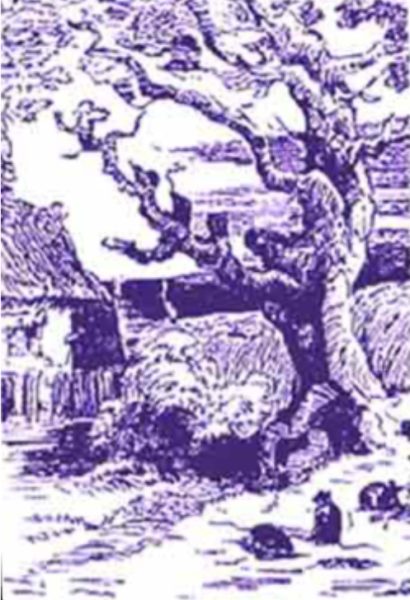
The phrase “Do you see the Cat?” was, and still is, often used by modern day Georgists to represent the idea of land inequality. The reason is that, in the image above, there is the shape of a cat hidden amongst the image, and like many other images of this variety, once you see it, you can’t unsee it. Georgists use this image to represent land inequality because once you see the issues that land inequality brings, you can’t stop seeing it.
The earliest known example of the phrase “seeing the cat” was a speech made by Judge James G. Maguire to the New York Anti-Poverty Society sometime in the 1880s. The following is an excerpt from a book called The Prophet of San Francisco, written by Louis F. Post on his experience hearing the speech Judge Maguire gave:
“I was one day walking along Kearney Street in San Francisco when I noticed a crowd in front of the show window of a store. They were looking at something inside. I took a glance myself, but saw only a poor picture of an uninteresting landscape. As I was turning away my eye caught these words underneath the picture: ‘Do you see the cat?’ I looked again and more closely, but I saw no cat. Then I spoke to the crowd. ‘Gentlemen,’ I said, ‘I do not see a cat in that picture; is there a cat there?’ Some-one in the crowd replied: ‘Naw, there ain’t no cat there. Here’s a crank who says he sees a cat in it, but none of the rest of us can.’ Then the crank spoke up. ‘I tell you,’ he said, ‘there is a cat there. The picture is all cat. What you fellows take for a landscape is nothing more than a cat’s outlines. And you needn’t call a man a crank either because he can see more with his eyes than you can with yours.’”
“Well, I looked again very closely at the picture, and then I said to the man they were calling a crank, ‘Really, sir, I cannot make out a cat in that picture. I can see nothing but a poor drawing of a commonplace landscape.’ ‘Why, Judge,’ the crank exclaimed, ‘just you look at that bird in the air. That’s the cat’s ear.’ I looked but was obliged to say: ‘I am sorry to be so stupid but I really cannot make a cat’s ear of that bird. It’s a poor bird, but not a cat’s ear.’ ‘Well, then,’ the crank persisted, ‘look at that twig twirled around in a circle; that’s the cat’s eye.’ But I couldn’t make out an eye. ‘Oh, well,’ returned the crank a bit impatiently, ‘look at those sprouts at the foot of the tree, and the grass; they make the cat’s claws.’ After a rather deliberate examination, I reported that they did look a little like claws, but I couldn’t connect them with a cat. Once more the crank came back at me as cranks will. ‘Don’t you see that limb off there? and that other limb just under it? and that white space between?’ he asked. ‘Well, that white space is the cat’s tail.’ I looked again and was just on the point of replying that there was no cat’s tail there that I could see, when suddenly the whole cat stood out before me.”
“There it was, sure enough, just as the crank had said; and the only reason the rest of us couldn’t see it was that we hadn’t got the right angle of view. But now that I saw the cat, I could see nothing else in the picture. The poor landscape had disappeared and a fine looking cat had taken its place. And do you know, I was never afterwards able, upon looking at that picture, to see anything in it *but* the cat. In my view, ‘the cat’ is the possibility of a world without privilege.”
This excerpt by Post is exactly the phenomenon that Georgists point to. Not only are those who see the cat called “crank” or “crazy” or just plain stupid, often times when trying to explain to others how to see the cat, it takes them explaining the entire picture until finally it is seen by someone else, and then never being able to see anything else in that painting. Thus representing the issue of Land Inequality.
Before we can talk about Georgism and why land inequality matters, we need to talk about Henry George. Now, who is Henry George? And why does he matter? Henry was born in Philadelphia and was raised there. Eventually, he moved to San Francisco during the gold rush, where he was hired as a printer for a newspaper. He eventually submitted several editorials, one, called “What the Railroads will Bring us,” (1868) became very popular and was required reading in California for decades. The editorial criticized the construction of the railroad, stating that the boom in railroad construction would benefit only the lucky few who owned interests in the railroads and other related enterprises, while throwing the greater part of the population into poverty.
George would then take a visit to New York City, in which he observed that those in poverty in a much older and richer city than San Francisco were worse off. This inspired him to later write his bestselling book, and the most important piece of Georgist literature, Progress and Poverty. He was previously a Linconite Republican, but eventually became a democrat. He ran for office a few times in California, although that didn’t have much success. Once he became a much more well-known journalist, he moved to New York City, where he would also attempt to run for office. He gained a very large following, but never succeeded in elections. He would have a stroke on the campaign trail and die the next day. His funeral was one of the largest in NYC history, and the largest since Lincoln’s death, with reportedly over 100,000 people attending.
Land Inequality is a phenomenon that happens when cities grow larger and larger, becoming more and more economically rich. Henceforth, the value being produced from land, and the value of owning land, becomes larger. Yet, those who do not own land, and those who don’t have the capital to affect land ownership, become poorer and poorer. This is a phenomenon we still see today. When land inequality grows, so does social mobility and economic inequality. Capital is then given only to those who are the land owners, such as corporations or large businesses, and not those who produce the value that gives capital. Georgist theories say that capital is not required to provide wages, and so by taxing the capital the land produces, you can provide better wages and benefits for the workers who produce value.
George’s most well known view is that of his idea of a Land-Value Tax, also known as the distribution of economic rent, which combined with other Georgist views would provide a better standard of living in proportion to the development of the city. He believed that the taxes gained from economic rent should be shared with the citizens of a municipality. Economic rent is, however, a certain amount of land produced versus however much was paid/is being paid for that land and utilities. He says by taxing land values, society could recapture the value of its common inheritance, raise wages, improve land use, and eliminate the need for taxes on productive activity.
George believed it would remove existing incentives toward land speculation and encourage development, as landlords would not suffer tax penalties for any industry or edifice constructed on their land and could not profit by holding valuable sites vacant. It is important to note that some Marxists have used this reasoning to justify nationalization; however, George did not condone nationalization and in Progress and Poverty George wrote, “I do not propose either to purchase or to confiscate private property in land. The first would be unjust; the second, needless. Let the individuals who now hold it still retain, if they want to, possession of what they are pleased to call their land. Let them continue to call it their land. Let them buy and sell, and bequeath and devise it. We may safely leave them the shell, if we take the kernel. It is not necessary to confiscate land; it is only necessary to confiscate rent.” Although it is true that he believed in limited Municipalization.
Another view George had is the idea of Municipalization of utilities and having free public transit. Georgists propose that businesses who rely upon “Right of way” passages are “natural monopolies” and so should be municipalitized to be either completely or nearly free. Right of way passages are things such as the transportation of utilities, like power lines, sewage systems, roads, waterways, information, goods, and travelers. An example of a natural monopoly in the modern day would be Amazon. Amazon uses publicly funded roads and highways to provide items to the consumers, they also use right of way passages such as elevators in cities or trains/airports to provide said goods to customers. Georgists would argue that the county municipality should instead tax the revenue of the land that amazon warehouses/factories/shuttle bays in order to provide money back to the public utilities used by customers of Amazon. The money gained from economic rent would be used to pay for electricity bills, water bills, toll road bills, anything that consumers of Amazon and the land owned by Amazon, as these are utilities that both the consumers and Amazon use that would stimulate economic growth. The idea comes down to the Henry George Theorem.
The Henry George Theorem states that when you invest into land’s public utilities, the land produces more value, and that when the amount of value produced by land is enough to pay off public utilities through economic rent, the rest of the money will go to the Municipality to provide what George called a “Citizens Dividend.”
Georgist’s Citizens Dividend is the idea that the surplus money generated by land value taxation would be given as a right to those without access to certain assets like housing, or not having enough money to pay for certain things like food. He argued that by making it a governmental right, it does not socially degrade those using it, unlike charities in which it is seen socially as “degrading” or even losing self respect. In a speech in the United Kingdom, George stated: “As an English friend of mine puts it: No taxes and a pension for everybody; and why should it not be? To take land values for public purposes is not really to impose a tax, but to take for public purposes a value created by the community. And out of the fund which would thus accrue from the common property, we might, without degradation to anybody, provide enough to actually secure from want all who were deprived of their natural protectors or met with accident, or any man who should grow so old that he could not work. All prating that is heard from some quarters about its hurting the common people to give them what they do not work for is humbug. The truth is, that anything that injures self-respect, degrades, does harm; but if you give it as a right, as something to which every citizen is entitled to, it does not degrade. Charity schools do degrade children that are sent to them, but public schools do not.” This is one of the biggest ideas that economic Georgists use to support having a Land-Value Tax.
Despite the many other views George had, these are some of the biggest. In my opinion, there are many things good with his theories, yet there are things that need to be improved upon. While his economic theories have much following in both Capitalist, Keynesian, and even in some socialist circles, and R/Georgism on Reddit has over 30,000 members, Georgism seems to be something that the modern-day progressive, liberal, or even conservative political parties seem to have forgotten. I believe that Georgism is an interesting way to tackle some of the failures of our modern-day economy, despite being over a century old. Georgism, to me, is a middle ground between Neoliberal, Libertarian, and Progressive economic theories, that allow almost every side to be content. Georgist economics stimulates the economy yet doesn’t leave the lower class behind during this economic process. Now, to ask you, the reader, Do you see the cat?