
[Warning: this article contains spoilers, viewer discretion is advised]
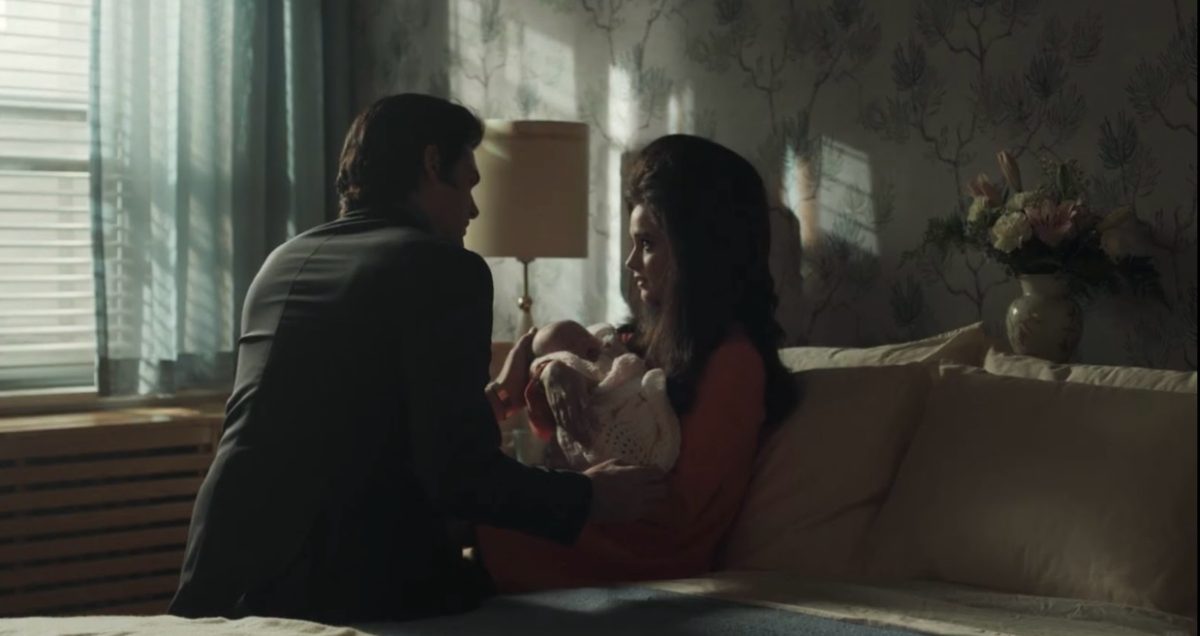
Directed and produced by Sofia Coppola, Priscilla is an American biographical drama that retells the life of Priscilla Presley and her complicated relationship with Elvis Presley through her own perspective. The film was solely based on the 1985 memoir Elvis and Me, written by Priscilla Presley.
While Priscilla is visually stunning and features strong acting performances, the film sacrifices historical accuracy for a dramatic effect, ultimately creating a version of Elvis and Priscilla’s relationship that is darker than what actually happened.
We are introduced to 14-year-old Priscilla, played by Cailee Spaeny, in 1959, while she is living in West Germany, where her stepfather is stationed with the U.S. Air Force. She soon meets famous 24-year-old rock ’n’ roll singer Elvis Presley, played by Jacob Elordi, just months before he is discharged from the U.S. Military.
Priscilla, already a major fan of his work, attends a house party at Elvis’ residence, where he is immediately drawn to her. Their meeting scene initially weirded me out. This is because Elvis and Priscilla had over a ten year age gap, something that would not be as easily accepted in the modern age of dating.
Despite this, the two continue seeing each other. Eventually, Elvis leaves Germany when his military service ends and does not make much effort to contact Priscilla, breaking her heart.
Three years later, however, he calls her and invites her to visit him in America at his residence Graceland. Priscilla enjoys her visit to Graceland so much that she does not want to return to Germany. When she eventually does, Elvis helps convince her parents to let her move to Memphis to live with him. When they finally agree, Priscilla finishes high school at a Catholic school.
Although life at Graceland appears to be glamorous, Priscilla becomes incredibly lonely and isolated as Elvis tours and films movies. When he is home, the film shows how Priscilla begins shaping her appearance to fit Elvis’ expectations, wearing only clothes he approves of, dyeing her hair to a jet black, and applying heavy eye makeup.
As their relationship continues, rumors of affairs begin to surface. These rumors are confirmed to be true, as Elvis had an affair with his Viva Las Vegas co-star Ann-Margret. When Priscilla confronts him, he dismisses her concerns, calling her insane and suggesting she leave for a while. This moment captures the overall tone of the film. Priscilla is being vulnerable, while Elvis responds with anger and resentment. She feels she has no choice but to forgive him, as she would have nothing if she didn’t have Elvis.
Eventually, Elvis and Priscilla get engaged and later marry. However, their relationship begins to decline further after marriage. Priscilla becomes pregnant with their daughter, Lisa Marie Presley, while Elvis’ career grows more intense. The film portrays Elvis becoming physically abusive during this time.
But, in Elvis and Me, Priscilla states that Elvis was never technically abusive toward her. The movie depicts this as the opposite, creating a darker tone and portraying Elvis as manipulative. The timeline also becomes inconsistent at this point in the film, including scenes that never happened in the memoir, specifically when Elvis throws a chair at Priscilla.
Priscilla eventually gives birth to her one and only daughter Lisa Marie. As Elvis grows more distant, she begins exploring her own interests outside of the marriage. In 1973, she decides to leave the marriage, informing Elvis in his hotel room before one of his shows that she is filing for divorce. She returned home to gather her belongings and say her goodbyes. The film ends with Priscilla driving away, leaving behind a life she once needed yet was never sustainable.
During a panel discussion at MegaCon Orlando, Priscilla Presley expressed that she “wasn’t really happy about the ending,” further stating, “Elvis and I ended very lovingly.” Which goes to show just how this movie can have a much darker tone than reality.
Additionally, the movie did leave out important moments from Elvis and Me, including Priscilla contemplating suicide, a significant part of her emotional journey that was excluded from the film completely.
On the other hand, one of the strongest elements of the film is its cinematography. Director Sofia Coppola uses soft lighting, pastel colors, and slow, quiet scenes to reflect Priscilla’s emotional vulnerability in this relationship. The glamorous settings of Graceland contrast with the loneliness Priscilla feels, making the visuals incredibly meaningful.
The acting also strengthens the film. Cailee Spaeny delivers a subtle yet powerful performance, capturing Priscilla’s innocence, at the beginning, and her growing independence as she becomes more mature later in life. Jacob Elordi portrays Elvis as charming but domineering.
Personally, I find Priscilla to be a relatable character. If a celebrity you admired wanted to date you, it would be easy to lose your sense of self-worth while living in fame. However, it takes courage to eventually recognize your value and leave a relationship that no longer serves you, as Priscilla ultimately does in the film.
I agree with Priscilla’s criticism of the ending. I also think the movie felt rushed at times, with noticeable time jumps that skipped important details, as if the directors were constantly running out of time.
Despite these flaws, I truly enjoyed the film. The visuals and acting were outstanding, and it was very entertaining to watch for the first time. Initially, I would have given it a perfect score. However, after all of the research I have done, I would rate it an 8/10 for inaccuracy. I would still recommend it to others, especially for its cinematography and the actors’ performances.



Andrew Duran • Feb 20, 2026 at 10:42 am
This is absolutely the best movie review I have ever seen! Great Work Cami!